
Ask almost any distributor what slows their team down, and route planning usually isn’t the first answer.
They’ll mention missed orders. Paper invoices. Inventory that doesn’t match what’s on the truck. Sales reps calling the office to check pricing. Drivers returning with handwritten notes that someone still has to enter into the accounting system.
Look closer, though, and many of those problems trace back to the same place. Field sales, deliveries, inventory, and accounting aren’t connected, so every stop creates more manual work.
Route sales software is supposed to fix that. The challenge is choosing software that matches the way your business operates. Some platforms concentrate on delivery management, while others extend into field sales, retailer ordering, warehouse operations, or route accounting.
Here are seven platforms that deserve a closer look.
1. SimplyDepo
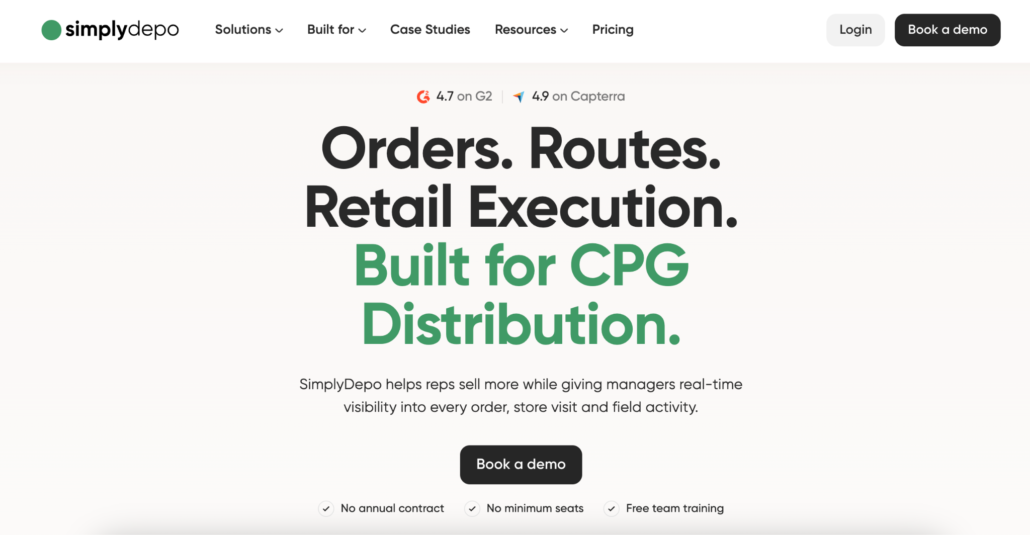
A route isn’t just a list of stops anymore. Every visit can include taking an order, making a delivery, collecting payment, checking inventory, updating customer information, or inspecting a retail display.
SimplyDepo brings those activities together instead of splitting them across separate applications. Sales representatives and drivers work inside the same mobile platform, allowing information to move directly from one stage of the workflow to the next.
When an order is placed, tomorrow’s route can be planned immediately. Drivers can generate invoices, collect payments, record proof of delivery, and synchronize everything with QuickBooks Online without waiting until the end of the day. If merchandising is part of the visit, shelf audits and photo reporting can be completed before leaving the store.
Key capabilities include:
- Route planning and optimization
- Mobile order capture
- Van sales
- Mobile invoicing
- Proof of delivery
- Shelf audits
- Planogram compliance
- Branded B2B ordering portal
- Offline functionality
- Native QuickBooks Online integration
Rather than treating route planning as an isolated task, SimplyDepo connects it to the entire delivery process. That reduces duplicate work and keeps sales, accounting, and delivery teams working from the same information.
A great choice for
Distributors that want field sales, route management, deliveries, and retail execution managed inside one mobile platform.
2. RouteStar Solutions
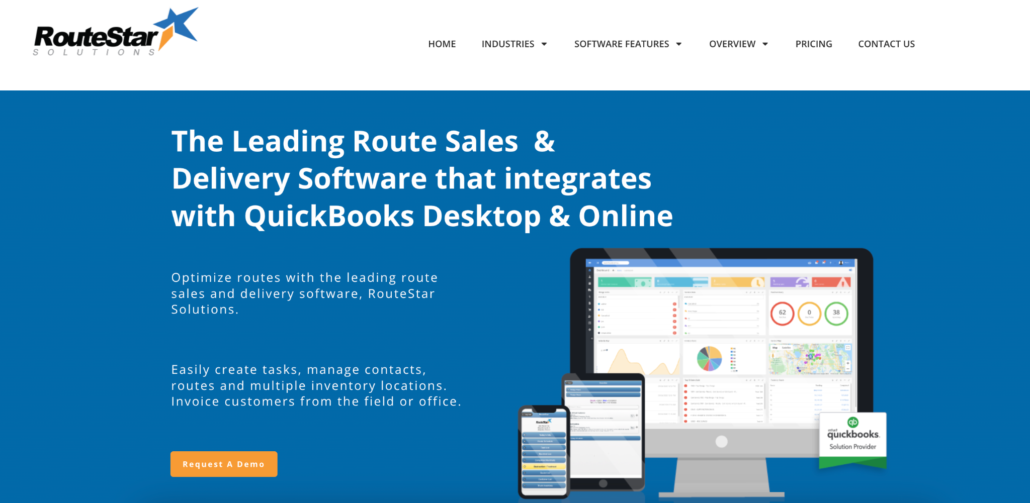
RouteStar Solutions stays focused on one thing: helping distributors run efficient delivery routes while keeping accounting synchronized.
Its strongest advantage is the close relationship with QuickBooks. Businesses already relying on QuickBooks for financial management can add route accounting, truck inventory, customer servicing, and delivery scheduling without replacing their existing accounting processes.
That focused approach makes the platform easier to understand than broader enterprise systems.
Core features include:
- Route accounting
- Route mapping
- Truck inventory
- Delivery scheduling
- Mobile invoicing
- Customer portal
- Two-way QuickBooks synchronization
For companies that don’t need merchandising or complex sales automation, RouteStar provides a practical set of operational tools centered around delivery efficiency.
Best suited to
Small and mid-sized distributors looking to improve route management while keeping QuickBooks at the center of daily operations.
3. LaceUp Solutions
Efficiency means different things depending on the business. For distributors supplying grocery chains, staying efficient often means handling compliance correctly the first time. Missing a DEX requirement or making errors during invoicing can create delays that ripple across an entire delivery schedule.
LaceUp Solutions has spent years building software around those operational realities. Alongside route accounting, it supports truck inventory, mobile invoicing, delivery management, and integrations with multiple ERP systems.
Highlights include:
- Route accounting
- Truck inventory
- Mobile invoasing
- Delivery tracking
- DEX invoicing
- Multi-ERP integrations
- Customer pricing
- Spanish-language support
Its strength lies in specialized distribution workflows rather than broader sales management or merchandising functionality.
When it makes sense
Businesses delivering to major retail chains or operating in environments where DEX compliance and advanced route accounting are essential.
4. Pepperi
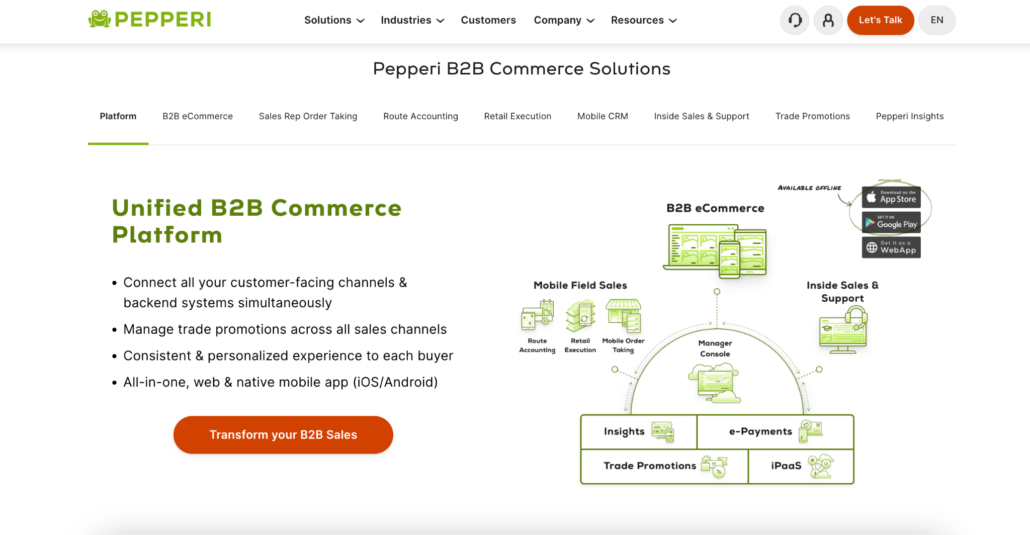
When route sales become part of a much larger operation, planning deliveries is only one piece of the puzzle.
Pepperi is built for organizations managing multiple sales teams, territories, pricing models, and ERP systems. Route planning fits into a broader platform that also covers field sales, B2B commerce, retail execution, and workflow automation. For enterprise distributors, having those functions connected can simplify large-scale operations.
Its feature set includes:
- Route planning
- Mobile field sales
- Retail execution
- B2B commerce
- Customer-specific pricing
- Workflow automation
- ERP integrations
- Multi-country support
Pepperi’s flexibility is one of its biggest strengths, though smaller distributors may find the platform more complex than their daily operations require.
A better fit when
Your business operates across multiple regions and needs route sales software that connects with enterprise systems and large field teams.
5. bMobile Route
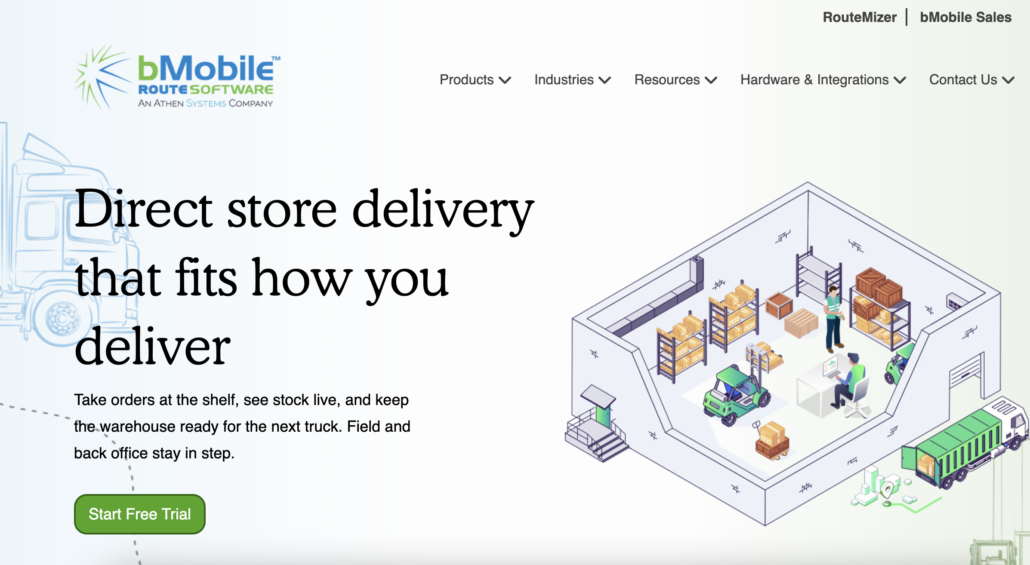
Few companies have focused on food and beverage distribution as consistently as bMobile.
Its software is designed around route accounting, truck inventory, customer deliveries, and warehouse coordination. Rather than trying to become an all-purpose sales platform, it concentrates on helping distributors manage daily delivery operations more efficiently.
That specialization has made it a familiar name in industries where route sales remain the core of the business.
Main capabilities include:
- Route accounting
- Truck inventory
- Delivery scheduling
- Mobile invoicing
- Warehouse integration
- Inventory management
- Operational reporting
- ERP connectivity
Businesses that prioritize inventory accuracy and financial reconciliation often appreciate the platform’s mature operational workflows.
Ideal for
Food, beverage, dairy, and bakery distributors whose delivery routes are tightly connected to inventory and accounting.
6. Orders in Seconds (OIS)
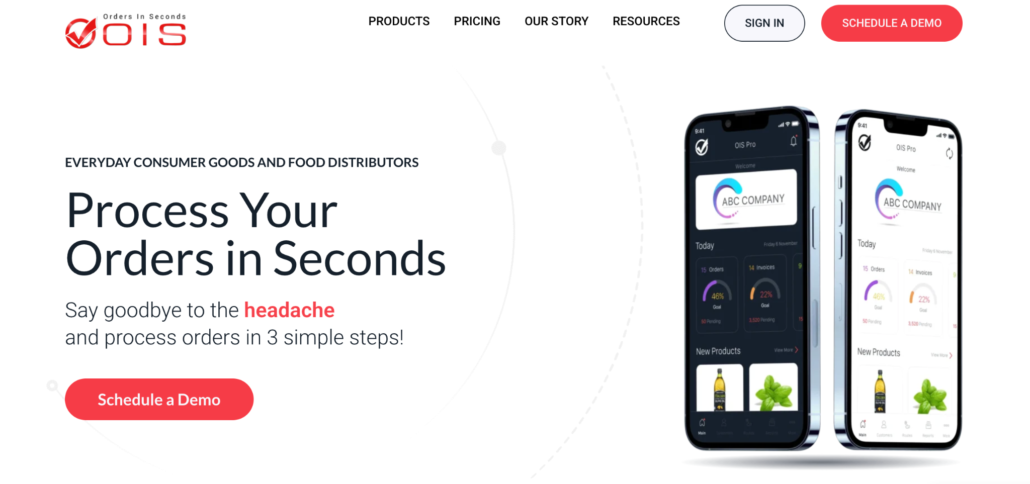
Efficient routes depend on more than navigation. If orders aren’t captured accurately before deliveries begin, the rest of the day quickly becomes difficult to manage. Orders in Seconds focuses on improving that first step by giving sales representatives fast access to customer information, product catalogs, pricing, and ordering tools while they’re in the field.
The platform integrates well with QuickBooks and supports offline work, allowing representatives to continue taking orders even without a reliable internet connection.
The platform includes:
- Mobile order capture
- Customer management
- Route sales support
- Offline operation
- Product catalogs
- QuickBooks Online integration
- QuickBooks Desktop integration
- Sales reporting
Orders in Seconds doesn’t try to replace warehouse software or become a complete route accounting system. Its strength lies in helping sales teams prepare accurate orders before deliveries take place.
A practical choice if
Your business wants to improve field order capture without investing in a larger enterprise distribution platform.
Route Planning vs. Route Optimization: What’s the Difference?
The two terms are often used interchangeably, but they solve different problems.
Route planning answers a simple question: Where should each driver go today?
Route optimization goes further. It analyzes factors such as customer locations, delivery windows, traffic patterns, vehicle capacity, and stop sequences to reduce unnecessary mileage and improve productivity.
For distributors running only a handful of daily routes, basic planning may be enough. As customer lists grow and delivery schedules become more complicated, optimization starts saving both time and fuel.
When Spreadsheet Route Planning Stops Working
Most distributors begin with spreadsheets because they’re familiar and inexpensive.
Eventually, though, the cracks become obvious. Routes are updated manually. Customer information lives in multiple files. Drivers work from printed schedules that change throughout the day, while office staff spend hours making corrections after deliveries are complete.
Software doesn’t remove every operational challenge, but it replaces many of those manual processes with information that updates automatically across the business. That’s usually the point where growing distributors notice the biggest improvement — not because routes become perfect, but because the entire delivery process becomes easier to manage.
FAQ
What is route sales software?
Route sales software helps distributors manage customer visits, delivery routes, mobile sales, invoicing, inventory, and related field operations.
Who benefits most from route sales software?
Wholesale distributors, food and beverage companies, self-distributing manufacturers, and businesses delivering products directly to retail locations.
Does route sales software include route optimization?
Some platforms do, while others focus mainly on route planning. The available functionality depends on the software.
Can route sales software integrate with accounting systems?
Yes. Many platforms integrate with accounting software such as QuickBooks Online, while enterprise solutions may also support larger ERP systems.
Efficient Routes Start With Better Workflows
The fastest route on a map doesn’t automatically create an efficient delivery operation. Real efficiency comes from connecting sales, deliveries, invoicing, inventory, and customer information so every stop moves the business forward instead of creating more administrative work. The best route sales platform is the one that fits those daily workflows — not simply the one with the longest feature list.